
A Pulitzer Prize-winning newspaper

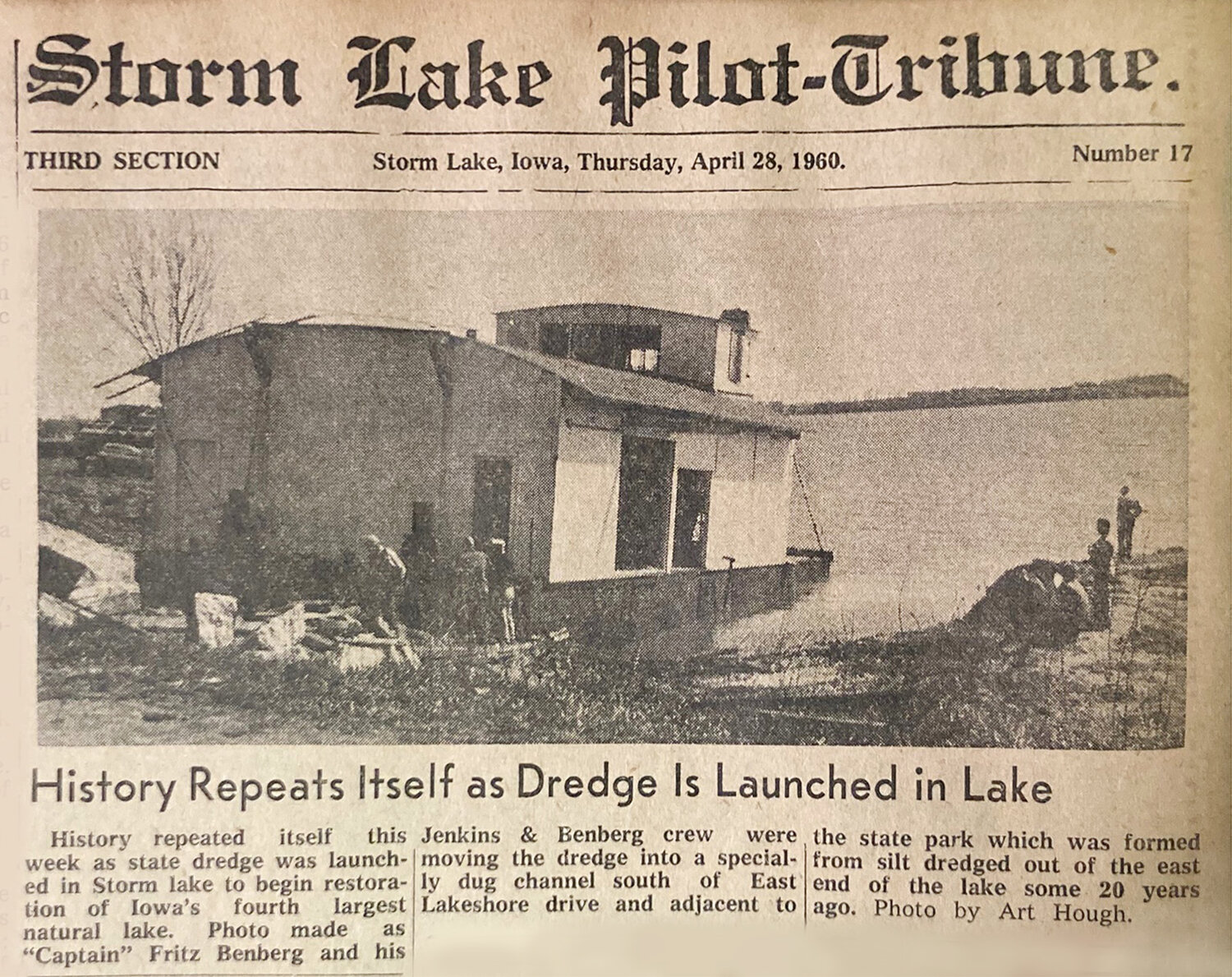
‘Dredgery was drudgery’
After graduating from St. Mary’s in 1963, for the summer I got a job as a deckhand on the dredge on Storm Lake. Additionally, after a brief few months at Devry Tech in Chicago, I returned to the dredge starting in February 1964 until I enlisted in the Air Force in June.
In either year, if you happened to be sitting with your sweetie on a bench in the dark at Chautauqua Park, you would have seen and heard, off in the distance, just east of the big island – The Dredge. From shore, it looked like a big white barn illuminated by bright lighting inside and out. It had a huge snorkel protruding out of front of it into the lake. You would have heard the distant muffled, oscillating whirring wine of its huge diesel motor.
Years earlier, as a Cub Scout at Band Shell Park, I remember participating in an event to raise funds to dredge the lake called “Save the Lake.” It was quite festive, with lots of people. Little did I know then that I would be part of the actual dredge work in the future.
My shift was on weekdays from 4 p.m. to midnight. There were only two of us, the foreman operator of the dredge and yours truly, who did all the hard work. (Trust me, it was hard.) We met every afternoon at a little inlet on East Lakeshore Drive across from the then Lakeshore Café by a small building that I believe was Frank Starr’s office. There was a dock there where we would embark on the work boat, to and from the dredge at shift change.
The work boat was about 30-plus feet long, maybe six feet wide and two to three feet deep. It was rectangular in shape with a smaller rectangular area cut out of the top deck that the crew occupied. It was like being in an oversized orange, rusty bathtub, flat across the top without any type of wind break, wind shield or railing. The forward flat hull curled up to break the waves. It had two levers, on the right and the left that, standing aft, the operator would steer and maneuver it. It was made of heavy plated steel. I often marveled that as heavy as it was, it could even float. It was a beast to operate, not just for transportation to and from the dredge but serving as a true work boat for toting large sections of pipe used to extend the entire pipeline.
So what if ‘it’s too rough out there’
Storm Lake, as my high school Spanish teacher, Senora Cruz referred to it “El Tormentoso Lago,” on many days certainly lived up to its name. There were days when the waves flowing into the inlet and all the way out to the dredge were just brutal. And of course, we could not just say “It’s too rough out there” and not go. We went, no matter what. On an extremely turbulent day, when I finally became adept at operating the beast, it was no small task getting out to the dredge. I steered it, standing aft with a lever in each hand, trying to maintain my balance to maneuver it, straight, directly into the waves, knowing that taking them at a wrong angle would certainly result in capsizing and send us both into the lake.
On real rough days the boat would virtually lift and bounce jarringly into each repeating wave creating huge overspray guaranteeing that upon arrival at the dredge with a dry spot on your person would be impossible. Some days it would take 20-30 minutes just to get to the dredge compared to 10 minutes on a calm day. On rough days, we were almost exhausted upon arrival, with seven more hours of hard work left to go.
The dredge inside was a huge wide-open cathedral ceilinged barn, lit up comparable to the vivid night lighting on a baseball field. There were two huge sliding garage doors on either side. At the front left, up a narrow set of stairs, was the control tower. Entering the center of the dredge from the center was a huge auger for digging into the lake bottom through about a 30 inch, plus diameter flow pipe coming out of the lake at a 45-degree and lowering it to the floor of the dredge, then out the back and down the pipeline to a depository point on the island we were building. Just imagine an old-style Electrolux canister vacuum cleaner with a clean nozzle and suction hose coming out the end of it.
On the left side at the rear was a huge generator that kept all the lights and electrical components working. On the right, at least twice the size, the larger diesel motor to run the auger and pipeline components. These two generators roared incessantly throughout our shift. Throughout the dredge were various storage cabinets for tools, dredge parts, life jackets and safety equipment and two work benches. The whole area was spotlessly clean.
Clearing out the rock jams
My deckhand duties? As mentioned, the dredge was spotless at all times. The two diesels sweat an oily substance 24 hours a day. Periodically, the deckhand wiped off the oil to make sure that it would not pond on the floor, creating a safety hazard. The overall floor was kept dry and clean at all times. Moments after we returned from an off-dredge task, it was swept and mopped immediately. While I was never in the Navy, I learned to understand what “Shipshape” really meant.
About that hatch… when the pipeline was jammed at that curve with a huge rock, the entire dredging operation was shut down until the rocks were removed. It was the deckhand’s responsibility to clear the jam. The hatch had to be removed with block and tackle and be out of the way. The opening was about four feet tall and 1½-2 feet wide, just enough room to maneuver in. You could not get into the pipe, so all the work was done with your upper body and a six-foot-long pointed steel shaft.
At times, you had to straddle the pipe or work on a ladder on either side of it. The jam could sometimes be just above the top of the hatch and was the easiest to remove. Other times, and most difficult, the jam was from where the pipe curved at the top, to a foot or more below the hatch opening — nothing but solid rock. It could take 15 minutes to over an hour to clear the various jams. I don’t know how much that pointed steel shaft weighed, probably at least 50 pounds. You could spend the whole time wielding that thing at various angles smashing rock until it became dislodged and/or removed. The really big ones, once loosened, had to be removed and thrown overboard behind the dredge. These big rocks were heavy. Getting them out of the hatch, down from the pipe was no easy task. The whole unjamming process required a lot of upper body strength.
Wimp was a skinny, crusty, older fart with the strength of Atlas
And perish the thought that the supervisor and especially if it was “Wimp” had to come down from the control tower and help. It was the “rite of passage” for a deckhand to do it without any help. I’m sure many preceding me did not survive. Wimp was anything but a wimp. He was, at first, a skinny, crusty, older fart, with the strength of Atlas who would test you over and over again until you proved that you could do the job. He would not speak, just yell orders until you got it.
I, on the other hand, knew that I would “grin and bear it” and eventually get it done. I was about as stubborn as Wimp was crusty. Once I had proven myself to him, he was just a hardworking, dedicated sweet older guy with a bit of crust that was just his nature. In fact, when the big jams happened and I had spent uninterrupted time beating at the rocks, he would come down from the control tower and we would work together as a team until we dislodged the massive jam. He was not always my supervisor, but when he was, he would always come down and welcome me aboard at shift change. I oft times have thought of him in the past when times have been tough for my teams and made sure that like Wimp, I supported them when a situation called for it.
Periodically, a rock would get jammed in the middle of one of the pipes on the lake. While the process was about the same, it was complicated by the movement of the workboat bobbing up and down on the waves. We had to disconnect the pipeline, secure it in place, remove the rock or rocks and finally reattached the pipeline, all the while trying to maintain our balance on the rocking boat.
Building the island one pipe at a time
The most arduous task of being a deck hand was to extend the pipeline, one pipe at a time, until we finished the island. It was not any easy task. It required, both Wimp and myself to complete. First of all, we had a barge piled with pipe sections. We had to take the workboat out to the barge, maneuver it so that we could, as easily as possible, offload a pipe section safely onto the workboat. The pipe was long, about 18 feet, heavy and cumbersome. Getting it on the workboat, without dropping it into the lake, (we never did) required both strength, agility and of course teamwork…Go Wimp!
The hardest job of being a deckhand started when we had to carry the pipe section to the end of the pipeline and attach it. We did this night or day, rain or shine. The farther we had to carry it the harder it was to get it there. The beginning of our trek had long before become solidified earth. However, at a certain point, the earth started softening up to a point when it was soft and squishy and very hard to get through on foot, much less awkwardly carrying an oversized, heavy section of pipe. We wore hip waders that, toward the end of the pipeline, required us to balance the pipe on our shoulders with one arm while using the other to pull the wader out of the mud on each step; hardest physical labor I ever did in my life. At times, it could take us over 30 minutes just to go 60-80 feet.
Once at the end of the pipeline, we maneuvered the pipe and sand braced it in place. Then, retracing our steps, went back dredging until another section needed placing. When we relocated the fill site from the island to the south lake side site, it seemed to take weeks until the earth began to harden, requiring us to slog in the muck on each section.
Memorable moments in the moonlight
On many nights, the roughness of the lake and bad weather made it excessively difficult to get through a full shift. However, there were nights when there were no pipeline extensions or trips to the mucky island, when the lake was as smooth as a mirror shimmering from a bright full moon and the star lit sky that were some of the most beautiful settings I have ever experienced, even better than the awesome Aurora Borealis I experienced in Alaska. On those nights I would grab a chair, sit in one of the barn-like doorways, peer out and just be in awe of its beauty and pondered what was I going to be when I grew up, and most certainly (smiling) how I was going to write about it 60 years later.
“I dub thee, Rick’s Island”
On the last night on the island, I snuck a small sign made up of a six-foot piece of wood and a piece of cardboard that read “Rick’s Island.” I hid it in the work boat. And on my very last trip last trip to the Island, I found a very obscure location and as I erected it in the firm muddy surface, I stated something like; “From the day forward, I hereby dub this island to be forever known as Rick’s Island.” Now you know! Much better than “the big island,” don’t ya think?
In June of 1964, I left the dredge and joined the Air Force. Trust me, I was in such great shape at basic training that my drill sergeant quickly assigned me as a squad leader because of it. End of the Dredgery, Beginning of Discipline!
Rick Wimer lives in Storm Lake.


Comments
No comments on this item Please log in to comment by clicking here